Monday, April 30, 2012

What motivates your students?


Recently, a short conversation with a Grade 12 student reminded me of the role of intrinsic motivation in learning.

Hers's how our conversation went:

Student: How was your day today Mr. Akune?
Me: Very good thanks. How about yours?
Student: Great! I went to Ms. Lewis' French 11 class during my study block today!
Me: French 11? During your study block?
Student: Yes, I enjoy learning French and Ms. Lewis is super cool.  I wanted to go. It was my choice! It's feels way different than when you 'have' to go to a class because someone else tells you to.
Me: That's pretty neat that you would do that during your study block. (Jokingly) Did Ms. Lewis assign you homework also?
Student: Actually she did! I don't 'have' to do it but I want to anyways. Being there made me realize how much I've learned in the past year. It's good practice and will help me improve.
Me: Really?
Student: Yeah, I like it. You know, I enjoy doing the work when I get to choose what I'm learning instead of being told what to learn. (Laughing) It's similar to cleaning my room. When my mother tells me to clean it I'm not so happy to do so, but when I decide on my own, I'm perfectly fine doing it.

In one of his webinars, author Daniel Pink (@Danielpink) described three factors that he believes are critical to enduring human motivation in the workplace. Autonomy, Mastery and Purpose.

Autonomy
Pink's ideas can be applied to student learning as well. For starters, he suggests that the key to engagement is providing autonomy over task, time, team and technique. This can sound challenging to offer within the structured curricula and schedules that seem to control the school day. So, what can we do?
  • Expose students to real-world challenges/problems and offer them the opportunity to solve the problem(s) they are most passionate about. Even within structured curricula, teach students to assess their own learning and allow them to choose the areas they wish to expand, deepen or strengthen their learning in.
  • Embrace the fact that no two students are alike and different students require different amounts of time to master their learning of different topics. As educators, this means constantly assessing student learning, building in flexible timelines and adjusting the pace and course of instruction to best meet the needs of individual students.
  • Encourage students to help each other. Be flexible and consider student input when grouping students together. Students are more likely to be engaged when they choose and are compatible with the people they are working with.
  • Differentiate! Allow students to choose how they demonstrate their learning. Don't force students to use a certain technique and consequently limit their ability to fully demonstrate their learning.
Mastery
Pink says the "single biggest motivator for people is making progress in meaningful work." The emphasis needs to shift from point gathering to learning! In classes characterized by an 'if you do...then you will receive...' environment, marks are used as a carrot.  This kind of environment may ensure the completion of simple, routine tasks, but will not stimulate the creative, deep thinking we wish to see from our students. Students may work to gather points but only until the point at which they have gathered enough.  Marks provide only temporary and extrinsic motivation.

On the other hand, feedback lets students know they are making progress and how they can continue to improve their learning. Feedback capitalizes on people's "inherent desire to get better at stuff."  Since students by nature want to get better, when we show them how they can improve, why wouldn't they try? When offered in the absence of a mark, feedback evokes the intrinsic motivation necessary to sustain prolonged learning.

Purpose
Pink suggests we ask the question, "Why are they doing the work?" Students must see a purpose, a 'real' reason for learning, a reason far superior to 'point gathering'. When students seek solutions to real-world problems, promote self-chosen initiatives and direct their own inquiries, intrinsic motivation drives their commitment.

So ask yourself...

What is your goal for your students?
Engagement or compliance?

What motivates your students? 
Learning or marks?


Thursday, April 19, 2012

Why don't students read my comments?


Let's be honest, we've all been there! Out of frustration, we've all asked, "Why don't students bother to read the comments we take so much time to write on the assignments we've just marked? 

There are a range of factors that may impact whether students read all of the comments made about their work, but I believe three factors play a big role.

1. Student view the mark as more important.
2. The feedback isn't timely.
3. Students see no opportunity to demonstrate improvement.

I'll go back in time to when I was in high school and learning how to drive. As a student driver I was offered lots of feedback on how I was progressing and what I could do to improve. Much like any teenager, I was highly motivated to learn and knew that it was important to do so in order to pass my road test.  The feedback was descriptive, specific, immediate and all along remained very supportive. Not once was I graded while I was learning and in no way was the feedback provided in a way that seemed judgmental. I always knew the feedback was designed to help me improve and I also knew I had opportunities to demonstrate my improvements. Because the feedback was so immediate, I did everything I could to apply the feedback and make the necessary improvements.

Eventually, the day of my road test came up on the calendar. To the best of my ability, I followed all of the evaluator's instructions and executed what was asked of me. When I finished my road test, I anxiously awaited the decision of the evaluator. When he told me the result (and yes, I did pass!) I remember feeling ecstatic yet relieved. I know the evaluator offered a number of comments about my driving, however, as much as I am ashamed to admit it, at that moment I didn't really listen too closely to his comments. Why not? For starters, my focus on the result overshadowed all of his comments. Second, because the evaluator's comments came at the conclusion of my road test, they weren't as helpful as they could have been if he provided them throughout the test. Third, I knew that my road test was complete and I wouldn't have to, nor would I be afforded the opportunity to demonstrate improvements based on his suggestions.

So, let's bring this back to our students who seemingly can't be bothered to read our comments. The problem probably doesn't lie in our comments themselves. In fact, on their own our comments would probably be very helpful and offer great suggestions for improvement. The problem likely lies in the fact that the work was 'marked'! The mark signifies that a judgment was made about their work and overshadows the importance of the feedback. How can we blame students for focussing on the 'mark' rather than the comments when we have made a judgment about their work? 

Assigning a mark also indicates a certain degree of finality. If students believe they no longer have an opportunity to demonstrate improvement, what incentive and motivation do they have to read the comments?   Our students viewed all the valuable comments we've taken the time to write as little more than a justification for the mark we assigned.  Why do we too often wait until the end of an assignment to provide the suggestions that students could use to improve their work?
So, what is the purpose of feedback?
Feedback should tell students what and how they can improve in their learning. It must be formative. The types of feedback offered by a teacher will differ based on the subject and learning task it pertains to. It might consist of suggestions on how to improve a draft of a written submission, point out how to correct a mathematical process, how to place one's fingers in order to play a note more clearly, etc.

And what can we do to increase the effectiveness of our feedback?
In order for students to act on our feedback, it must be timely. Feedback, being formative in nature, must be consistently provided during the process of learning so that students can incorporate the suggestions into their work and into their ongoing practice. Regardless of the type of feedback, what's crucial is that students be provided the opportunity to apply the feedback to their work.  This means that a mark should not accompany feedback. Feedback must precede the mark. This tells students that the feedback is designed to help them improve their work before a judgment is made. Students should not be penalized in the gradebook for errors they make while learning. We must provide opportunities for practice without penalty!


Friday, March 23, 2012

Assessment shift: Learning or Learning on time?


The classroom is a busy place for a teacher. In high schools, every block means roughly 30 more students, each bringing his/her own strengths, weaknesses, interests, personalities, etc to the class. We know that each student is unique, will learn in different ways and at different rates, but too often we make a generalization and refer to them as our 'English 9 class' or our 'Block G class'. Likewise, because we are faced with the organizational challenge of working with so many students we put expectations on our students that they will all learn at roughly the same pace. Too often, the unintended consequence is that we emphasize 'learning on time' instead of what we should emphasize...LEARNING!

This post focusses on a few assessment practices that educators can implement within a busy 'class' that will embrace each student's individuality and support...
  • students learning at their own pace
  • learning as an ongoing process
  • students learning from their mistakes
Learning Logs
There is a lot for students to learn each class. Sometimes students grasp concepts immediately but most of the time the end of a class signifies a forced interruption to their learning process. When you consider students repeat this same process four times each day, you can start to understand why it's quite easy for students to forget precisely what they were working on when they were interrupted, what they've already mastered and what they need to continue practicing. 

Enter the learning log! Learning logs can exist in a variety of forms. What is important about a learning log is that a student writes down the specific learning targets for the class and self-assesses his/her own progress towards these targets at the end of each class period. The self-assessment could be as simple as a 'green light, amber light, red light system' where students assess themselves a green light if they've mastered a target to the extent that they could teach a peer, amber light if they are getting there but need some more practice and a red light if they need to stop, ask a question, then practice with some guidance from the teacher.

What is most important about a learning log is that it encourages students to track their own progress towards the mastery of learning targets.  Learning logs focus students' attention on their learning progression towards targets rather than simply trying to meet deadlines for completing work. Learning logs also offer students a way to go back in time and update their progress towards a target that they were previously unable to meet, even if the learning target came from a previous unit or term.  Learning logs also recognize that we should be encouraging our students to learn from their mistakes. Say a student uses teacher feedback to correct a process he/she was previously applying incorrectly to solve a certain type of problem.  Even if a student goes beyond the initial timeline for the class to demonstrate he/she has made an improvement, his/her progress is still valid and should be acknowledged.

Flexible Deadlines
Too often, our practices indicate to our students that we are more interested in the timeliness of their learning and less about the depth and quality of their learning.  Inflexible due dates, late penalties and zeros for work not yet completed all send the message to students that as much as we value learning, we place greater value on the fact that they learn certain things by a certain date. These practices penalize the slower learner and force him/her to hastily complete work rather than learn for the sake of understanding. If we truly want to encourage deep learning, we must allow students the necessary time to do so and our assessment practices must reflect this belief.

Here is where the flexible deadlines come in! Does it really matter whether a student learns to solve an algebraic equation or write a chemical formula today instead of next week or next month? Ultimately, are we more interested in seeing students learn or learn on time? I'm not suggesting we should eliminate deadlines completely, but I do think we need to offer our students a little bit of flexibility and acknowledge that some students are going to require a little more time to master certain concepts. Furthermore, our assessment practices should reflect students' most recent improvements in learning.  Just as the new learning of a concept replaces the previous learning of the same concept, new assessments of a student's level of mastery of a concept should replace previous assessments of student's level of mastery of the same concept.

Redo's
Say a student, despite his efforts, struggles to master a concept by the time the class writes a major test. The student performs poorly, receives a low mark, but seeks the assistance of his teacher, who re-explains the concept so that the student understands. Days later, when the teacher checks with the student to assess his level of understanding, the teacher determines that the student now has a solid understanding of the concept. Shouldn't the student's mark on the test now reflect the teacher's most recent assessment? Or at the very least, doesn't the student at least deserve the opportunity to rewrite a similar portion of the test that he struggled with the first time? I would say so! After all, if we want students to accept our feedback, learn from mistakes and we acknowledge that our assessments should reflect students' most current learning, then allowing redo's is a logical step. I'm not suggesting that redo's become a free-for-all. I believe students need to earn their chance at a redo by creating and following through with a plan for improvement. It is ok for students to 'fail' at things but it is unacceptable for them to be 'failures'. By offering redo's we send the message to them that when they make mistakes they will have the opportunity to learn from and improve upon them.

Monday, February 27, 2012

Surviving or Thriving?

Consider the profile of a student who is 'surviving' school.

He/she...
  • appears disinterested, disengaged and bored in class. 
  • seems lazy and unmotivated     
  • requires the push from the teacher in order to get going on anything in class. 
  • appears to be going through the motions and just 'doing school', seemingly without purpose.         
  • is content with simply 'passing' each course.


Why are some of our students just 'surviving'?

Unlike life outside of school, much of the learning in schools (high schools in particular) is organized in a manner that lends itself to learning in silos. Students attend separate classes for Math, Science, Social Studies, English, etc. Students are asked to learn course-specific concepts and skills independent of what they are being asked to learn in other courses. Of course, there are interdisciplinary connections between the different courses but we too often force students to create the connections on their own. As a teacher it is easy to focus on the course curriculum at the expense of pointing out to students how their learning connects across disciplines. Because we often fail to help students see how their learning fits into a bigger picture, students can feel as though they are being asked to learn decontextualized nuggets of information. And since the lives they live demand the application of interconnected skills and knowledge from various disciplines, they struggle to see the relevance of what they are learning at school.

Compare this to the profile of a student who is 'thriving' at school.

He/she...
  • is highly motivated and passionate about learning new things and ask questions beyond the scope of the class.
  • regularly talks about what is happening at school.
  • takes initiative and explores new ideas. 
  • has high expectations and works hard to achieve his/her goals.
  • sees how his/her learning will lead to future plans


What can lead to more of our students 'thriving'?


Daniel Pink (@danielpink), author of Drive: The Surprising Truth About What Motivates Us argues that three factors (autonomy, mastery & purpose) contribute to enduring motivation. The following are some quotes from one of his recent webinars.

  • Autonomy: "the technology for engagement is self-direction"
  • Mastery: "the single biggest motivator is when people are making progress in meaningful work"
  • Purpose: "how & why are they doing the work?"


I believe we need to create more opportunities for 'big-picture' learning, where students explore big, important questions from a range of angles. Through self-driven inquiries, challenges and initiatives students should engage in authentic interdisciplinary learning opportunities that they are passionate about and can see are relevant to their present and future lives.

Consider how much different school might look and feel if we allowed greater opportunity for students to have input into and self-direct their own learning. What if, under the guidance of a teacher, students could...
  • propose problems and challenges they wished to solve?
  • propose initiatives they wished to accomplish in their school and community?
  • share their learning and progress towards self-directed inquiries and initiatives with the school, community and the world using a variety of technologies?
An example of what this might look like is the Pathways program at Mount Abraham Union Middle/High School where students, through a personalized program, develop their own curriculum and become invested in inquiry.

My guess is that if we allow students greater opportunity to personalize their learning, they will be more motivated to learn and experience more fulfillment from their learning. I would hope this would contribute to fewer of our students surviving and greater number of them thriving!


Sunday, February 5, 2012

What are students saying about Edcamp?

This is my third reflective post about Edcamp Delta. This time it's about the value of student voice and recognizing student input and perspectives when it comes to improving teaching and learning.

15 students from Delta Secondary, 2 students from other Lower Mainland high schools and a few recent high school graduates participated at Edcamp Delta. Although they comprised just under 15% of the participants, they had powerful voices and their contributions enriched the dialogue.

Alex (@alex_gaio) led a discussion about the use of Google Apps in Education. He and a group of other Delta Secondary students also facilitated a conversation about Focus Groups and Student Engagement. Antony (@AntonyTsui) facilitated a session called Are you assessing my REAL learning? Meanwhile, Mackenzie and Gloria (@gloriakhj) shared their perspectives in a panel discussion about successes and challenges in education.


Following Edcamp Delta, I was fortunate to speak with many of the student participants about their experience. Here are some of the comments they volunteered.

"The teachers listened to us. I feel like they cared about what I had to say."
"The adults made sure they included us in the conversations."
"We all felt like equals at Edcamp. The only time I felt like I was a student was when the adults specifically wanted to hear the perspective of a current student."
"I think the teachers learned a little bit about where we're coming from as kids. I also learned about some of the pressures that teachers are facing."
"At school we get taught. At Edcamp we got to participate."

As I reflect on these comments, I think about how different an Edcamp is compared to a traditional classroom.  In a traditional classroom, a hierarchy exists between the teacher and the student. The teacher is the 'expert' and the student is the 'learner'. The culture is such that the student is expected to learn from the teacher but not the other way around.

At an Edcamp, there is no hierarchy. People aren't cast in the role of 'teacher' or 'student', 'expert' or 'learner'. The expectation is that educators can learn from students equally as much as students can learn from the educators. In most instances, students and teachers learn together at an Edcamp.

The key difference at an Edcamp is that each participant approaches the event with a curiosity and desire to learn. Rather than asking students questions that the teacher already knows the answer to, at an Edcamp teachers are asking questions that they don't know all the answers to. So instead of the teacher quizzing students and dispensing information, at an Edcamp teachers are learners who seek the input, opinions and ideas of students.

Imagine how different the culture and tone of a typical classroom would be if teachers were regularly posing questions that they didn't already know the answers to. Imagine if students viewed their teachers as 'learners' rather than 'experts'. Imagine if students and teachers regularly learned together.

When it comes to education, adults tend to make most of the decisions for students. We do have more life experience, and yes, we have all gone through school. This cannot be ignored. But what also can't be ignored is that the world is changing and our students are living a different experience than we did.

If we truly hope to prepare our students for their current reality and their lives in the future, we MUST create opportunities for student voice. BC Student Voicethe BC Education Plan and Edcamp Delta  are a great start!

Wednesday, January 25, 2012

In 'Flow' at Edcamp

This is my second reflective post following my participation and involvement in planning for Edcamp Delta. Having now participated at two Edcamps (Edcamp Vancouver was my first), what has struck me is that on both occasions, I have been in 'flow' throughout the events.

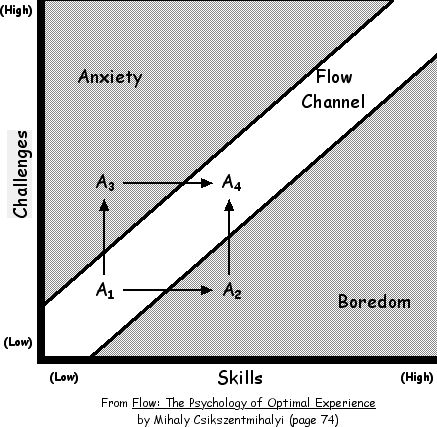
For those of you less familiar with the concept of 'flow', Mihaly Csikszentmihalyi refers to it in his book 'the psychology of optimal experience'.  He summarizes the common characteristics of flow as:

  • …a sense that one’s skills are adequate to cope with the challenges at hand, in a goal-directed, rule-bound action system that provides clear clues as to how well one is performing.
  • Concentration is so intense that there is no attention left over to think about anything irrelevant, or to worry about problems.
  • Self-consciousness disappears, and the sense of time becomes distorted.
  • An activity that produces such experiences is so gratifying that people are willing to do it for its own sake, with little concern for what they will get out of it, even when it is difficult, or dangerous.
Graph of FlowAs learners, we are intrinsically motivated to seek conditions of flow. According to Csikszentmihalyi (see graph), “skills” and “challenges” are the two key variables in the flow experience. As a learner's skills (and knowledge) about a particular topic grow, the level of challenge must increase in order for him/her to stay in 'flow'.


What attracts me to most education conferences is the specific topic and presenter. I approach these conferences with genuine enthusiasm since it isn't everyday I have the opportunity to listen to an expert in the field of education. Unfortunately, in some cases I have come away disappointed. It's not that I've disagreed with the information or advice but sometimes the presenter has provided information I've already heard, strategies that are already part of my daily practice or some combination of information and strategies which either don't apply to my work or which I lack the requisite knowledge to build on.  In other words, I quickly became bored because I wasn't challenged to learn something new or I tuned out because I lacked the prior knowledge to connect the new ideas to. Compounding this is the fact that 'experts' often take a transmissive approach and as a result it has been difficult to interact with the content and personalize the learning to my own context.

Edcamps are different! Participants display an energy and enthusiasm that is contagious. Throughout the day participants introduce themselves to one another, reacquaint themselves with old colleagues and engage passionately in conversation. Sessions do not consist of 'experts' telling passive listeners new information. Rather, edcampers ask questions, seek advice and share their successes, failures, challenges and learning. They contribute ideas and are equally as interested in helping build others' knowledge and skills as they are their own. Participants engage in dialogue and respond directly to one another.  There is a wealth of expertise in the room but there isn't one expert at the front of the room. Because participants have chosen the discussion topics they are interested in, the sessions are lively, engaging and allow each participant to make meaning and contextualize the conversations they've heard.


I have never been bored at an edcamp because the conversations challenge my thinking and force me to reflect on my current practice.  If anything, as sessions conclude I find myself with the desire to continue the discussions into breaks and over lunch.  As Brian Kuhn (@bkuhn) recently tweeted, "Edcamp is like a hallway conversation on steroids!"


The social nature of an edcamp also occurs through a conference backchannel.
The Twitter backchannel at Edcamp Delta was so popular that at one point in the afternoon the hashtag #edcampdelta was trending.


Similar to the face-to-face conversations, participants use the backchannel to tweet comments they've heard, ask questions, reflect on their learning and share resources. The backchannel also allows people who are unable to participate in person to follow the discussion and contribute from a distance.

I'm always shocked when each session concludes and when the day draws to a close at an edcamp. Being so intensely focussed, time seems to slip by so quickly. Because I've been concentrating so hard throughout the day, I find myself mentally exhausted as the day wraps up. However, I also find I'm inspired by the ideas and experiences that people have shared with me during my many conversations.

I'm thankful to have engaged in so face-to-face and backchannel conversations at Edcamp Delta and Edcamp Vancouver and I know they have allowed me to construct meaning and apply my learning to current situations and challenges I face at school.  I'm also grateful to the participants who have peaked my curiosity, led me toward new challenges and kept me in 'flow' at Edcamp!

Wednesday, January 18, 2012

Edcamp Delta: A Personalized Learning Experience

Recently in British Columbia, much is being said about the need for personalization. The Ministry of Education's new BC Education Plan emphasizes the importance of personalized learning.
We must not confuse personalization with individualization and differentiation.

"Personalized learning is not individualized learning, in which students share the same learning goals but progress through the curriculum at their own pace. Nor is it differentiated instruction, in which students also share learning goals but receive instruction that is tailored to their learning needs.

Personalized learning is an instructional approach that encompasses both differentiation and individualization, but is also flexible in content or theme to match the specific interests and prior experiences of learners."

Personalized learning really takes into consideration that long tail of interest, of prior motivation, of languages. It leverages all the different things that people have in their repertoire to add value to their learning. In any personalized learning model, the student - not the teacher - is the central figure."  Karen Cator

But what does personalized learning actually look like? feel like?

Well, on Saturday January 14th I participated in a personalized learning experience at Edcamp Delta.

For those of you less familiar with how an edcamp works, let me briefly explain.
  • There is no keynote speaker and no set topics.
  • Participants propose discussion topics leading up to and in person on the morning of the event.
  • Participants vote for topics that interest them and based on the popularity of the respective topics, the organizers arrange the discussion topics within a grid and create a schedule for the day.
  • Participants choose to participate in sessions they are most interested in.
  • One or more participants step forward to initiate the conversations in each session. 
  • Participants share ideas, perspectives and experiences with each other. They respond to each other's questions and queries.
So, what key features of an edcamp contribute to such a personalized (not just individualized or differentiated) learning experience?
  • Participants arrive with different goals for the day. Some wish to network, others want to share ideas about specific topics and some want to ask questions.
  • The content is flexible and participants choose discussion topics based on their specific interests and prior experiences.
  • Each participant contributes and adds value to the other participants' learning.
  • Face-to-face and backchannel conversations take place within each session but participants may choose to extend their conversations throughout the day.
  • There is an absence of hierarchy. There is no 'teacher', no 'expert' and no passive attendees trying to soak up information being delivered by the 'guru' in the room. All participants are learners, helping one another.
What transpires from this is truly remarkable. Each participant is deeply engaged and exudes a passion for learning. Being surrounded by such energy and enthusiasm is both motivating and inspirational. And one is guaranteed to walk away from an edcamp event curious about a new topic and wanting to continue a conversation started earlier in the day.

So, in British Columbia as we look to reshape education in a way that supports personalized learning, maybe we should be considering the success of recent Edcamps and borrow key aspects from the 'unconference' model of learning.

Imagine how the notion of school might change if learners had the choice to investigate self-directed inquiry topics based on their curiosity and interests?
Imagine if learners shared questions and problems with their local and global network and challenged each other to think critically and be creative problem-solvers.
Imagine if learning was made more social, with more emphasis on learning together, where learners communicated, cooperated and collaborated in an effort to build shared knowledge and understanding?

Undoubtedly, this would lead to more questions about our current model of 'schooling'.

Organizationally, how might this look in a class? in a school?
How might this impact curriculum? Would this lead curriculum to emphasize skills more than knowledge?
How would this alter the traditional role of the 'teacher' and 'student'?

I recognize these are not easy questions to answer, but neither is the challenge of envisioning a personalized learning system for all students in BC!